n an act of shared creation, Sheida Soleimani works with her parents, mâmân and bâbâ, to reconstruct stories, from her childhood, of their escape from Iran. As active collaborators in her work, both narrate their experiences as pro-democracy activists compelled to flee the country while Iran’s regime cracked down on political dissidents.
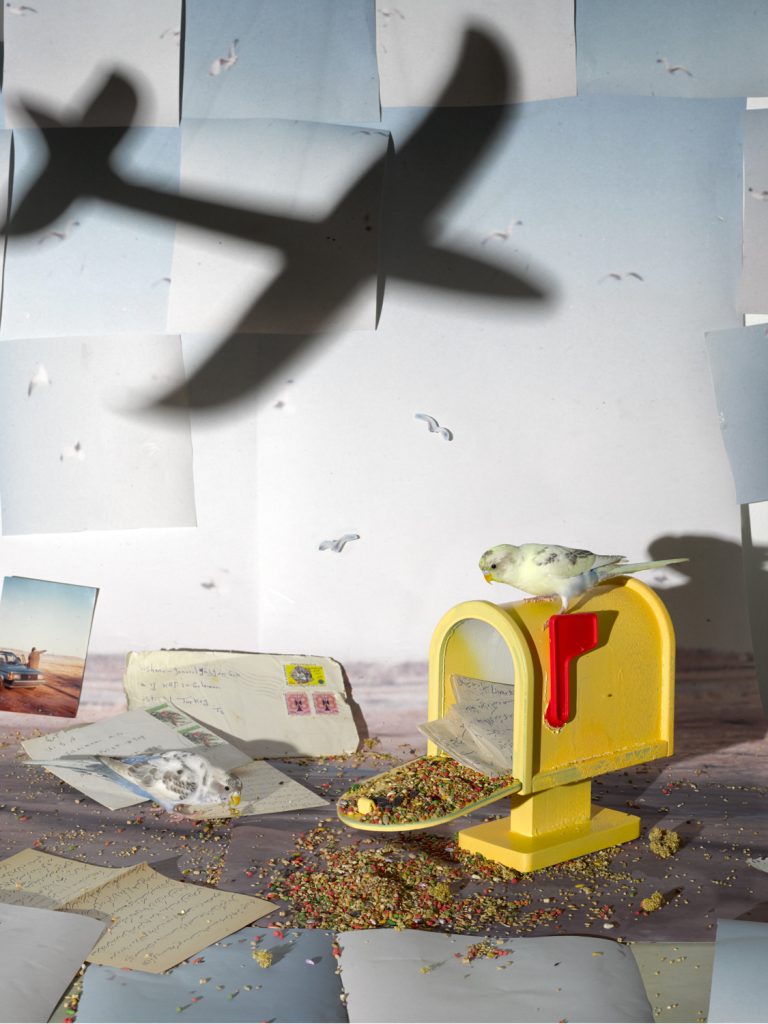
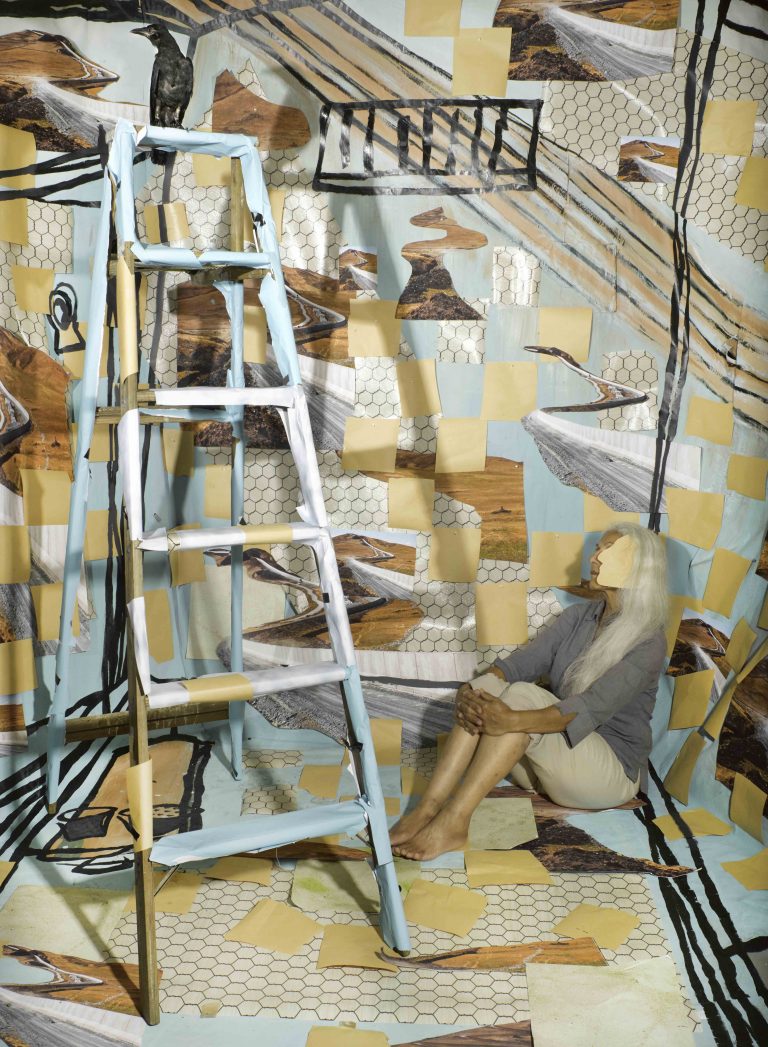
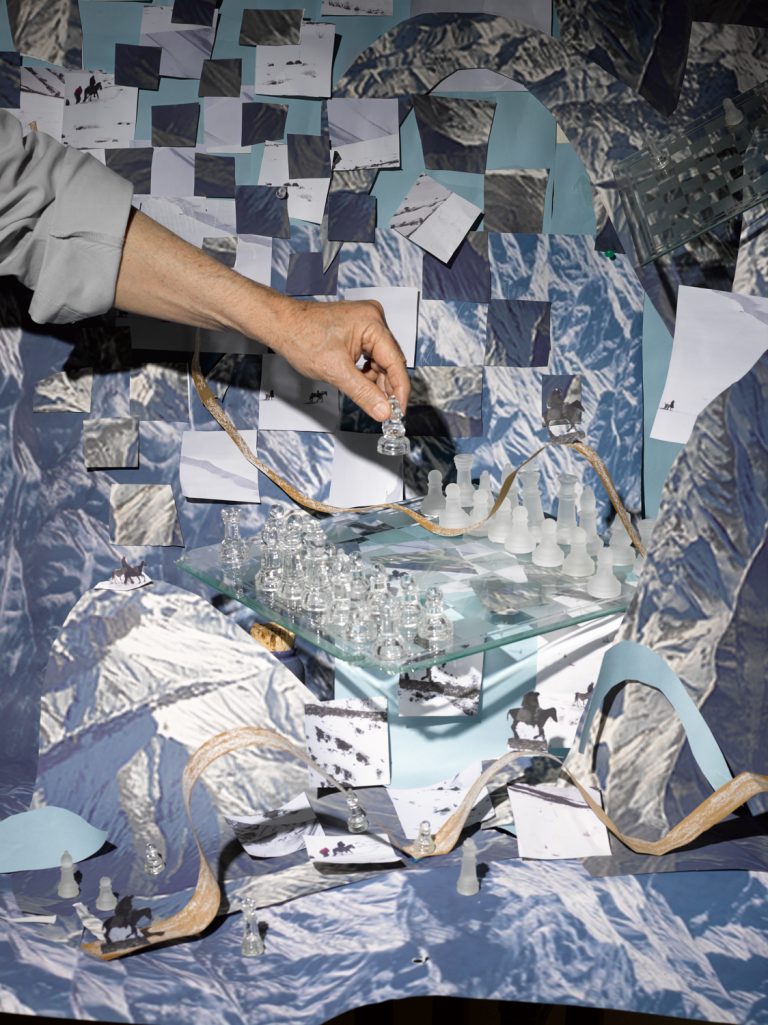
However, true to any exercise of recounting the past, Soleimani’s images do not attempt to relay any one, overarching truth. Instead, her sculptural tableaus embody a kind of worldbuilding, inspired by magic realism, which underscores the fragmented and often anachronistic nature of memory. They lay atop the drawings made by mâmân and bâbâ that speak anecdotally to the details they remember of their journey. While the images refer to fact—her father’s escape on horseback or her mother’s solitary confinement, for instance—they do not attempt to furnish evidence or portray a neatly resolved outcome. Instead, they use collage to enable a rupture, revealing the artifice of the photograph and freeing it from the burden of authenticity.
While casting mâmân and bâba as protagonists, Soleimani makes a larger commentary on migration and the political right to move freely across territories. Drawing not only on their experience of crossing the Iranian border, but also looking at the obstacles facing the flight of birds, she gestures towards the perils of man-made infrastructure for both human and non-human life. This inclusion is not incidental, but tied closely to her family history and her lineage of pastoral care.: Soleimani is also a licensed wildlife rehabilitator, having developed the skill of caregiving passed down to her by mother. These birds that don supporting roles in the narrative are symbolic of the thousands that attempt to take flight despite hostile frontiers. Soleimani’s kaleidoscopic vision of her personal history opens up the possibility for a multiplicity of perspectives to chart political histories.
Sheida Soleimani is an Iranian-American artist, educator, and activist based in Providence, Rhode Island. The daughter of political refugees who escaped Iran in the early 1980s, Soleimani makes work that excavates the histories of violence linking Iran, the United States, and the Greater Middle East. Working across form and medium—especially photography, sculpture, collage, and film—she often appropriates source images from popular/digital media and resituates them within defamiliarizing tableaux.
Sheida’s work is held in major collections including the Guggenheim Museum, MFA Boston, Pennsylvania Academy of Fine Arts, MIT List Visual Art Center, and KADIST Paris. Widely exhibited and published, she is the Assistant Professor of Studio Art at Brandeis University and a licensed wildlife rehabilitator.