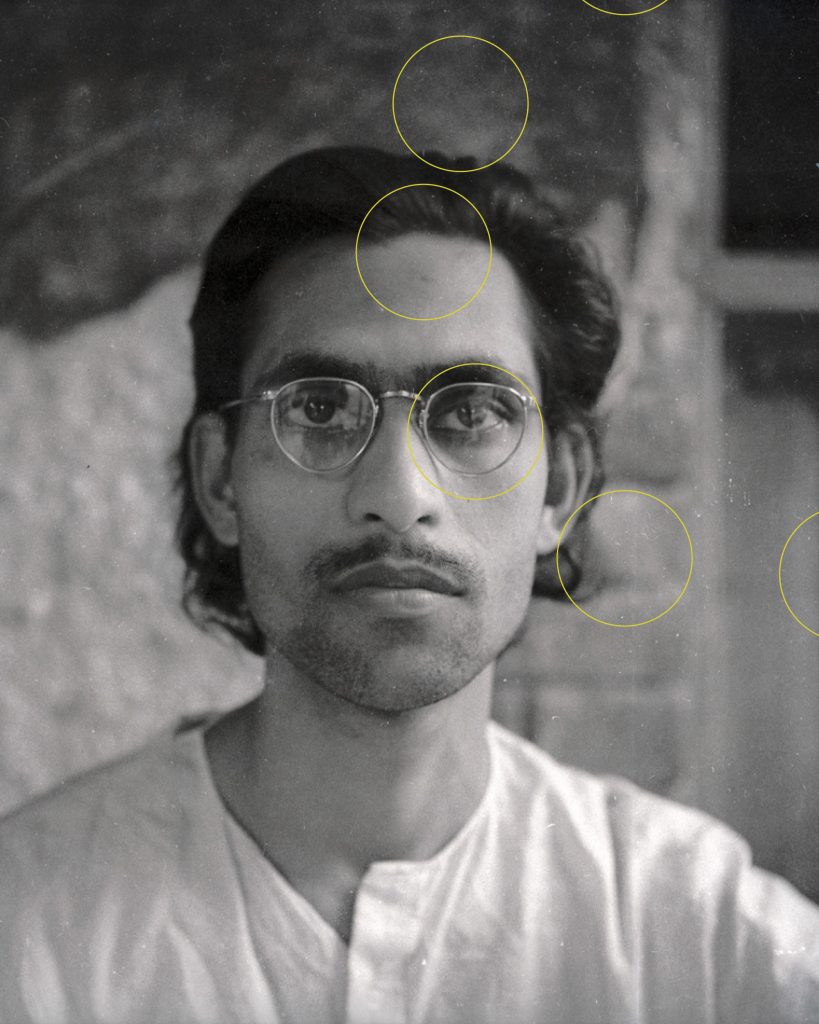
Amanul Huq stands among the pioneers of creative photography in Bangladesh. From childhood, image-making drew him in—first as lines on paper, then as light through a lens. At sixteen, armed with a Baby Brownie, he wandered from village to village, documenting agrarian life. Each frame is rooted in the Bengal Delta and becomes more than a pictorial record of its landscapes and people.
Huq’s photographs open like silent theatre. He sought a visual language that could hold the pulse of a nation—a world shaped by rivers, labour, light and the stubborn dignity of human presence. His lens traced ordinary gestures, the tilt of a wrist drawing water, the posture of men at rest, a boat slicing through afternoon light. Huq did not hesitate to stage images when emphasis was required. This theatricality, shared with the cinematic experiments of Satyajit Ray, reveals his instinct for mise en scène. His celebrated image Idle Noon, praised by Ray, demonstrates Huq’s disciplined observation and refusal to separate form from feeling.
His photograph of the slain language-martyr Rafiq Uddin Ahmed remains one of the most enduring visual records of that event: an image that challenged state narratives and became a symbol of truth and resistance. His archive of political events—the language movement of 1952, the 1969 mass uprising, and the long path to liberation in 1971—does not seek grand narratives. It simply stays with the people, telling their struggles as they unfolded. Huq was not interested in merely documenting events; he was seeking the image that transforms memory into belonging. His lifelong series Amar Desh (My Country) remains a poetic document of the land and its people. Huq’s photographs are lucid, humane and cinematic: images that refuse to look away, and in doing so, allow a nation to look inward.Huq’s photographs open like silent theatre. He sought a visual language that could hold the pulse of a nation—a world shaped by rivers, labour, light and the stubborn dignity of human presence. His lens traced ordinary gestures, the tilt of a wrist drawing water, the posture of men at rest, a boat slicing through afternoon light. Huq did not hesitate to stage images when emphasis was required. This theatricality, shared with the cinematic experiments of Satyajit Ray, reveals his instinct for mise en scène. His celebrated image Idle Noon, praised by Ray, demonstrates Huq’s disciplined observation and refusal to separate form from feeling.
Collection from Drik Picture Library Archive
Research Ahmed Arup Kamal and Shahadat Parvez